Rotas that respectthe rules you set.
Tell RotaTeam how your business really runs. Get a week that covers the floor, honours contracted hours, and explains anything it couldn't do.
Secure account required · Nothing published until you say so
Everything the week needs
Three areas, one workspace
Scheduling
Rota planning
Whole-week planning
Every shift solved together, not one at a time
Cover requirements
Minimum on the floor, per role, per day, per hour
Shift lengths
A shortest and longest — and a normal one if you have it
Handovers
Whole-team changeover, or staggered through the day
Cross-cover
Say which roles can step in for each other
Your team
People and hours
Contracted hours
The minimum you owe, treated as an obligation
Weekly targets
What you aim to give — never turned into a cap
Availability
Day by day, per person
Working preferences
Keep people apart, or roster them together
Skills
Shifts that need a qualification get someone who has it
Oversight
Cost and attendance
Labour cost
The week’s spend before you publish it
Budget
Set it, see it, stay inside it
Clocking
Scheduled start against what actually happened
Punctuality
Recorded, weighted by time of day, excusable
Requests
Swaps and leave alongside the rota
Why the rota comes out better
The scheduling detail most tools skip
Shift lengths with a reason
A ten-hour day doesn’t become ten-hour shifts. Lengths are chosen to fit the hours your team actually needs — so you get a 4, a 5 and a 6 where that serves people better.
Handovers that make sense
Cover changes where demand changes, and parallel shifts stagger so the whole floor never turns over at once. Unless you’d rather it did — that’s a setting.
It tells you what’s wrong
Every finished rota is re-checked against your rules. If something can’t be satisfied you get the reason in a sentence, not a score that quietly absorbs it.
Set up by describing it
Weekday and weekend hours, who covers what, who wants the long days. Type it the way you’d say it, and corrections stick.
Setup
Say it once, in your own words
Different hours at the weekend. A supervisor who can cover the floor. Someone who prefers the long days. Type it the way you'd say it out loud — and it stays stored the way you said it.
- Different opening hours on different days
- Corrections applied, not argued with
- Named people, not headcounts
- Read back to you before anything is saved
You type
“Weekdays 4pm–9pm, weekends 11am–10pm. Two on the floor, one supervisor, and supervisors can cover the floor if it saves money.”
It stores
How it works
Three steps
Describe your business
Opening hours, roles, pay, and the cover a normal day needs.
Generate the week
A full rota against your rules, with the cost and any conflicts up front.
Adjust and publish
Change anything by hand, or describe the change and let it redo the week.
Sound familiar?
Nobody went into business to build rotas
It’s a few hours a week that produces nothing, and it’s the job that goes wrong quietly.
Sunday night, again
The rota gets built in a spreadsheet after everyone else has gone home.
Someone’s short
You find out on payday that a contracted 20-hour person got twelve.
The awkward ask
Two people who shouldn’t work together, and you have to remember why.
It falls over
One person calls in sick and the whole week has to be redone by hand.
What setup looks like
You talk. It listens, and asks the right things back.
We’re open nine to nine, seven days. I need two on the floor all day and a supervisor on at all times.
Got it — 09:00 to 21:00 every day, two floor staff plus one supervisor. Can any of your supervisors cover the floor if you’re short?
Yeah, supervisors can work the floor. But I only ever want one supervising at a time.
Understood. So a second supervisor on shift works as floor cover, not as a supervisor. How many days in a row is too many for someone to work?
Four, and everyone gets two days off.
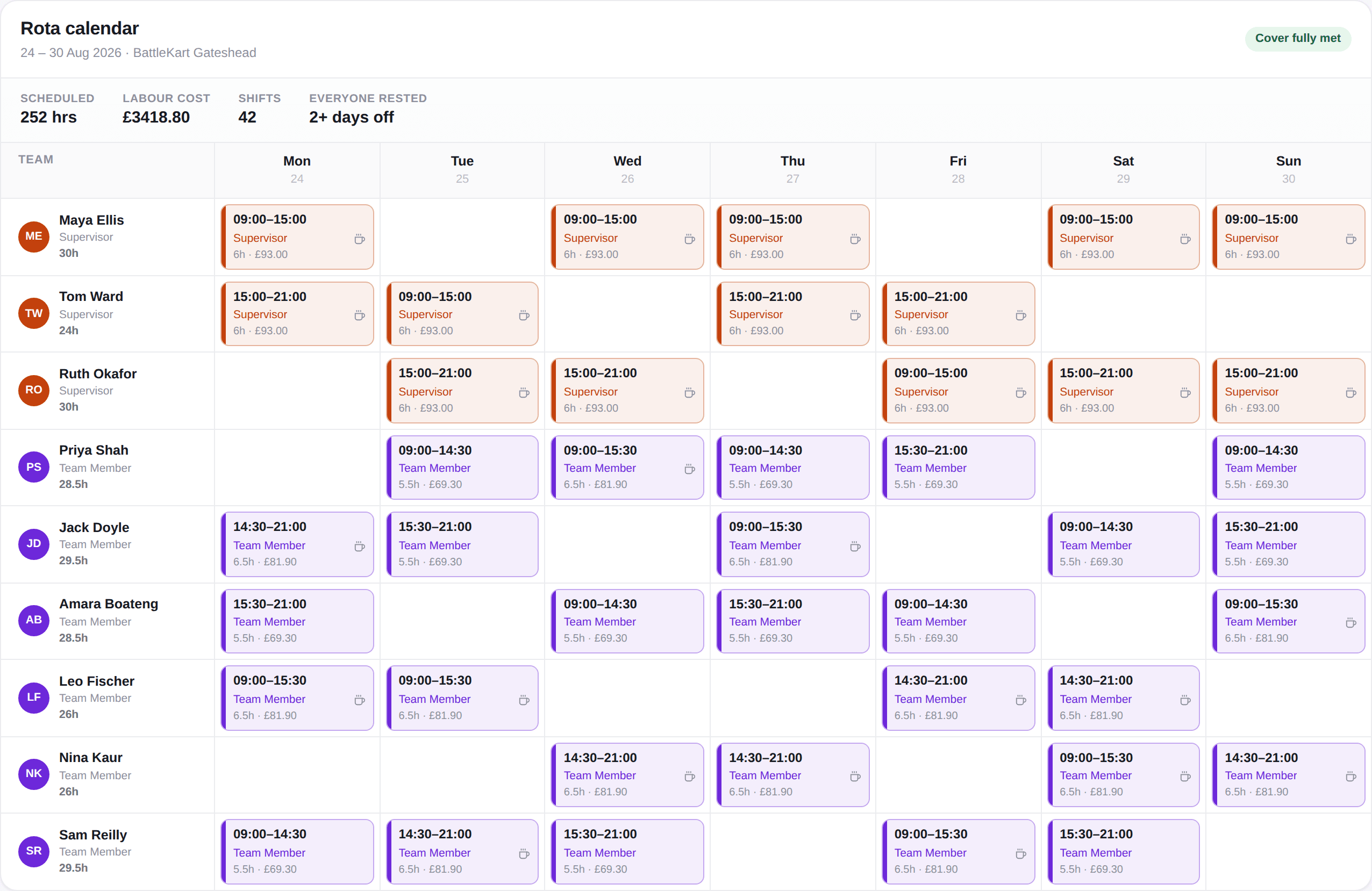
Noted. That’s 252 staff hours a week to cover — with your team of nine, everyone can have their two days.
Notice what it asked about: cross-cover, a cap on supervisors, days in a row. Those are the details that make a rota usable, and they’re the ones a form would never think to ask.
Straight with you
What it won’t do
Most of the value in a rota tool is in what it refuses to fudge.
It won’t pretend a rota works when it doesn’t
If the cover you’ve asked for can’t be staffed with the hours you owe people, it tells you exactly where and why — the day, the times, and who’s short. It doesn’t hand you a rota with a quiet hole in it.
It won’t put everyone on the longest shift
A long shift is exceptional. It’s given to someone when it’s the only way to reach their contracted hours, not because it makes the maths tidier.
It won’t decide anything on its own
Every rota is a draft. You read it, change what you like by dragging shifts around, and nothing reaches your team until you publish it.
It won’t check your employment law for you
It follows the rules you give it. Working time regulations, rest breaks and your own contracts are still yours to know — we’d rather say so than imply a guarantee we can’t make.
Your team’s data
You’re trusting us with other people’s pay
Names, wages, hours and availability for people who never signed up to anything with us. We treat that as the serious thing it is.
Separated in the database
One business cannot read another’s data — enforced by the database on every query, not by code remembering to check.
Hosted in the UK
Your data stays here, which keeps it under UK data protection law rather than someone else’s.
Yours to remove
Delete your business, or your whole account, from Settings. It goes.
Before you ask
Questions
- How long does setting up actually take?
- A few minutes of conversation. You describe the business in plain English — opening hours, who works there, what cover you need — and it asks about anything it still needs. There are no forms to fill in and nothing to import.
- Can I change the rota it gives me?
- Yes, in two ways. Drag any shift between people or days, or describe the change in words — "put an extra person on Saturday evening" — and it rebuilds around it. Your rules still apply either way, so a change that would break your shift lengths or leave cover short is refused rather than quietly applied.
- What if my business isn’t a café or a shop?
- Nothing in RotaTeam is built around a particular trade. Roles are whatever you call them, and the rules — shift lengths, cover, days off, cross-cover — are the ones you state. If you can describe how your week works, it can plan it.
- Do my staff need accounts?
- No. RotaTeam is for whoever builds the rota. Staff logins are something we’ll add once we can do it without putting everyone’s pay in front of everyone else.
- Where does my data live?
- In a UK-hosted database, separated at the database level so no other business can reach it — not by our code remembering to check, but by a rule the database enforces on every single query.